
In the last five years, a perfect storm of economic downturns, political instability and public health crises has driven reported stress levels to alarming highs. In 2023, one-third of U.S. adults said they feel completely stressed out no matter what they do to manage their stress. I am sure many of you can relate.
Toxic stress may seem like an inevitable part of life, but it doesn’t have to be. Dr. Elissa Epel, a leading expert on stress, well-being and optimal aging, tells CuraLink that it is possible to break the cycle of chronic stress. In doing so, people can prevent damaging health effects linked to unrelenting negative exposures. To learn how to reset the mind and body to experience transformative benefits, read on.
A conversation with Dr. Elissa Epel
Dr. Elissa Epel is a uniquely practical academic. Rather than examine far-fetched psychological theories, Dr. Epel tests how everyday tools like meditation or cold therapy can promote psychological and physiological thriving.
Dr. Epel is a professor, vice chair of psychology and director of the Aging, Metabolism and Emotion Center at the University of California, San Francisco. She is co-author of a New York Times best-selling book The Telomere Effect and author of The Stress Prescription.
In her work, she examines the environmental, psychological, behavioral and social factors that impact cellular aging. Dr. Epel’s research has uncovered a troubling truth: Chronic stress makes us sick, mentally and physically. But by using self-care techniques like deep rest and breathwork, it is possible to stop stress from wreaking havoc on our health and even harness “positive hits of stress.”
While modern living is brimming with anxiety-inducing events, people can build stress resilience and learn to ride the waves of life without drowning.

Elissa Epel, PhD, Professor and Vice Chair of Psychology, Department of Psychiatry and Behavioral Sciences, UCSF Weill Institute for Neurosciences and Director, Aging, Metabolism and Emotion Center, University of California, San Francisco
What sparked your interest in studying the biopsychosocial effects of stress?
Ever since I was young, I’ve been hungry for information about the mind-body connection. I studied psychology, biology and physiology in college and went on to pursue clinical psychology to study human behavior.
I conduct studies on how different interventions or practices affect people’s physical, psychological and emotional well-being. I’m also a high-stress person, and psychologists often study their own issues. I don’t claim to have mastered what I study, but I certainly use research insights in my daily life.
How do you define stress, and what are the various types?
It’s important to distinguish between stressors or situations that happen that stress us out and our own personal stress response.
We can’t control many of our circumstances in life, including the occurrence of traumatic events, natural disasters and unwanted situations as well as the conditions that we are born into. But we can somewhat control our responses to whatever happens.
That’s why we focus so much on stress resilience—how to train people to surf the waves of adversity without going under water or feeling too overwhelmed, stressed or anxious. While those responses are natural and automatic in the moment and can shape a strong energetic coping response, they can stay active in our minds and create mental disorders and physiological dysregulation over time.
There are many kinds of stressors: social stressors from our work or personal relationships, environmental stressors such as neighborhood violence and psychological trauma and abuse. Childhood trauma, in particular, shapes the developing brain to be overresponsive to future stressors. As adults, we spend most of our days at work. Jobs with low control and high demand are a common chronic stressor, which in turn predicts worsening of our health like increased abdominal fat as well as risks of heart disease and even mortality.
“Stressors are not distributed equally.”
Women, people of color and people who have any type of marginalized social identity are exposed to a greater frequency and intensity of socially embedded stressors—these include psychological stressors like being targets of harassment and prejudice, lower control at work and structural stressors like discrimination. That helps explain why we see stark stress-related health disparities.
How stressed are people today compared to decades past?
People often say that we aren’t more stressed than our ancestors. Humans have faced hardships throughout history including existential threats to our survival. But the types of threats today are qualitatively different from the past. There is now more potential for our self-destruction through political and climate instability, both of which are human created, through how our minds work and how these shape our beliefs and social behavior.
Compared to our ancestors, we are better at keeping our stress response on constantly, even when we aren’t facing immediate threats. The most common type of stress is caused by our own stressful thoughts.
We have a perfect storm for constant stress—from the news and social media, urban living and general busyness. We tend to rush all the time. We aren’t experiencing restorative or stress-reducing contexts that were naturally built into the day, like walking from place to place and being in nature.
“We have a cultural tendency to find honor and glory in busyness or hardship.”
We often discuss stress in a way that gives it high cultural value and status. On top of this, we are not only saturated with personal drama but also exposed to mega-stressors from global situations that we have no control over.
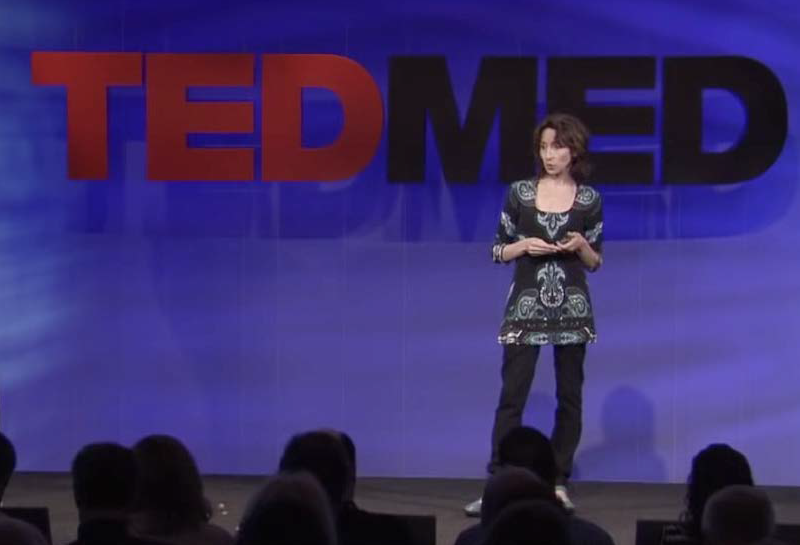
Dr. Epel at TEDMED 2011. In her work, Dr. Epel examines the environmental, psychological, behavioral and social factors that impact cellular aging. Her research has uncovered a troubling truth that chronic stress makes us sick both mentally and physically
There is empirical evidence that we are more stressed now based on perceived stress surveys that ask questions like: “How often do you feel overwhelmed? How often do you feel that there are demands that you can’t face?”
How does chronic stress influence our telomeres and epigenetics and, in turn, our health?
Intense feelings of stress are a red flag, health-wise. Over months and years, high-stress perceptions predict worse immune responses, such as excessive levels of inflammation in response to stress or worse—chronically at rest. That is called “inflammaging” because inflammation can accelerate biological aging. It can also lead to changes in epigenetics affecting how our genes work and leading to a profile of epigenetic aging (also called accelerated epigenetic clocks). Over years, chronic stress leads to shorter telomeres, the protective caps at the ends of our chromosomes. When our telomeres shorten prematurely, this may reduce our cells’ abilities to divide and regenerate, leading to old and inflamed tissue. Dysfunctional telomeres can send signals to the mitochondria impairing their function as well.
Can you explain the typical acute and chronic stress response in humans?
The acute stress response is both necessary and beneficial. It helps us adapt to changes in everyday life. While it feels unpleasant in the moment, the acute stress reactivity is designed to mobilize energy to our extremities and muscles to flee if needed. It also mobilizes resources like glucose and energy from our mitochondria. We recover from bursts of stress very quickly, especially if we don’t mentally relive the experience over and over.
Our acute stress response and recovery can help us develop more resilient cells. We build what I call “stress fitness” by exposing ourselves to short-term and manageable stressors. But when the acute stress response occurs too frequently with too little recovery or even no full recovery, short-term stress turns into chronic stress. Your body adapts by developing what we call allostatic overload. Instead of having a low resting baseline, the setpoint of our nervous system and other regulatory systems increases so that we are ready to respond to a threat at any moment. High allostatic load wears out our bodies’ regulatory systems including the vessels of our cardiovascular system, so that we are more likely to develop high blood pressure. At the cellular level, it breaks down the ability to repair DNA and other damage within cells.
What should people understand about the long-term effects of chronic stress?
It’s easy in the modern world to go with the flow. Most people’s default mode involves moving through the rush of life with the mindset of: “I don’t have enough. I can’t do enough. I’m not enough.”
That chronic stress mindset makes us always feel that we have less self-worth. It drives a different physiology than the ability to feel that you have enough and appreciate it. That second mindset allows your nervous system to feel at ease. So there is a mindset and lifestyle that goes along with the “not enough” view that puts us at risk of depression, anxiety and constant stress.
It’s a stress habit that we all tend to have from the moment we wake up. That “rush mode” is tied to how your body calibrates its stress response for the day and how fast we age at the cellular level. Rushing means you are tied to the clock, which amps up your nervous system. Alternatively, we can slow down our perception of time and let our cells turn on their restorative activity.

Dr. Epel’s research has found that by using self-care techniques like deep rest and breathwork, spending time with loved ones, in nature and with our pets, it is possible to stop stress from damaging our health
But people can break the cycle of chronic stress. Outside exposures are not monolithic or unending. There are always opportunities to use mindful awareness to consciously relax and take a break from habitual vigilance.
What are the toxic health effects of living in a cloud of chronic stress without enough rest and recovery?
Chronic, low-grade stress, including the uncertainty of not knowing what’s next, keeps our internal alarms on.
At the most fundamental level, chronic stress ages us because it shifts cellular metabolism into a high-speed mode. In that high metabolic state, aging accelerates too. It also induces changes in our epigenetics, telomeres and mitochondria.
Chronic stress impairs mitochondrial energy production. We have shown that people who have more chronic stress, including those who are parental caregivers of children with chronic conditions, tend to have lower mitochondrial health. Their mitochondria can no longer make as much energy or adenosine triphosphate as they need.
How bad is chronic stress for our long-term health?
It’s a slow drip. Immune disorders, particularly autoimmune disorders, can be triggered by stressful events. But, in general, we don’t get diagnoses of chronic diseases until years later, typically after age 50. Once we have a diagnosis, it’s often too late to reverse chronic disease, and it’s more about management. But we can think about our cellular aging daily and how responsive our resilience is to our daily mental and emotional health as well as our lifestyle.
For example, you may be stuck in a high-demand, low-control job. If you can’t change your job, then you can try to break up chronic stress throughout the day by minimizing toxic exposures to situations and people that create unsafe feelings or environments.
Safety is very important for our biology. Take breaks as much as possible not just by leaving work but actually changing either the environment around you or what your body is doing. Slowing breathing can be hard to remember, but it’s the quickest, fastest way to reset your nervous system during a stressful day. I suggest people do it when they wake up or go to bed so that it’s built in as a daily resource for their body. But of course, any other time is helpful too.
What are your favorite tactics to recalibrate on a day-to-day basis?
Get in touch with love.
“Connecting with a supportive person is one of the most stress-reducing acts we can do.”
Social support isn’t very novel, but it is fundamental to how we work as social mammals, and it works as a stress buffer. We feel less stress when we are connected to feelings of love and have a purpose.
Showing gratitude in small ways is one of the qualities of the happiest people. It’s a two-for-one—it makes the giver and recipient happy. Even though we hear about gratitude a lot, it’s incredibly important for our ability to cultivate our positive emotional well-being. We have a free citizen science study you can join called The Big Joy Project. It is a 7-day experiment that helps you get in touch with love, gratitude and kindness, qualities that we know promote better emotional and mental health. You can learn what works best for promoting joy for you.
In your latest book, The Stress Prescription, you describe the power of a hit of stress. Why are these “stress shots” so powerful, physiologically and psychologically?
Our natural tendency when we feel stressed is to seek ease, relief and relaxation. Sometimes that’s what we need. But our nervous system also needs workouts via positive hits of stress. Think about it this way: A shot of espresso or a cup of coffee can be exhilarating, but if we’re having them all day, they keep the stress response high. We feel jittery and anxious and eventually exhausted.
“Hormetic shots of stress reset our cells and regulatory systems.”
Short, manageable stressors like heat, cold and HIIT (High-Intensity Interval Training) can harness the positive stress response to burn up excessive stress hormones like cortisol, glucose and insulin; reduce inflammation and, as we recover from that stress, change our baseline to induce a slower heart rate, slower respiration and better heart rate variability.
How can deep rest and contemplative practice combat the toxic side effects of stress?
If you engage in a mind-body practice, like qi gong, yoga or mindful breathing, in as little as five minutes, you will likely feel a dramatic change in your body’s autonomic nervous system and your emotional state. You might not feel that immediately the first time, but it’s something you can practice and condition.
Aim for at least a five-minute wellness pause daily.
Your body doesn’t know the difference between different types of contemplative practices such as prayer or meditation; it responds positively to all of them. So the goal is to find what you love and will do.
Longer breaks can lead to a deeper reset in our cellular function and nervous system. Many people have studied retreats and long-term meditators. These extended periods of deep rest change the brain signals to our cells from “fight, flight, freeze”—the kind of vigilant state of expecting stressors—to a calmer mode of trusting the prolonged biological safety signals. That allows people to turn on restorative and rejuvenating processes in their cells while they’re awake, not just during sleep. We have just published a new model showing why our cells respond to feelings of social safety and to any practice that slows our breathing.
One of the consistent findings emerging from many studies on meditation is that it reduces inflammatory gene expression. Our research suggests that it also promotes telomere stability and mitochondria activity. That’s why people feel energized.
Are you under chronic stress? At the end of the day, ask yourself: “How exhausted am I? Did I recharge my battery today? Is there something I can do now?”
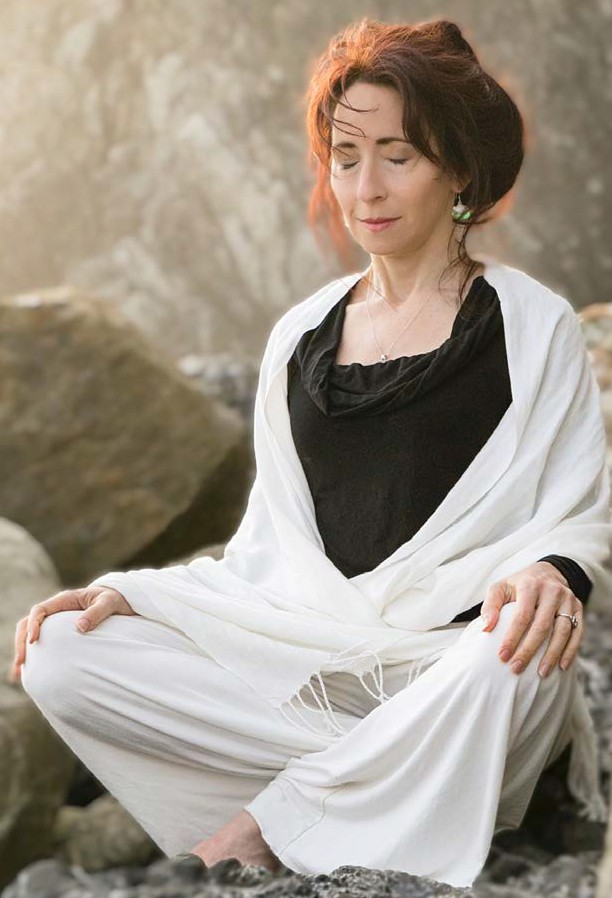
Sensory experiences like aromatherapy and mind-body practices such as meditation reduce stress arousal and help us develop stress resilience. Dr. Epel recommends nature walks, ideally three times per week, with increased sensory awareness and engaging in a mind-body practice like yoga or mindful breathing for at least five minutes a day. Free daily meditation audios can be found on Insight Timer and Plum Village
Are there any stress-busting techniques or technologies that you’re excited about? What’s next in the field of stress science?
There’s no single answer for everyone in terms of reducing stress. For some people, monitoring stress with biosensors can be helpful. In some cases, people get too neurotic and wearing a sleep monitor will make them lose sleep because they’re over-interpreting and over-worrying about a few bad nights. But, in general, biosensor monitoring allows us to see the positive effects of simple things like going to bed earlier, which can lead to better sleep habits.
Studies of the default mode network have shown us how we can be stuck in self- focus mode (especially with negative thoughts!), and the antidote is getting out of our focus on thoughts and engaging with our bodies and sensory awareness. So that includes exercise and mind-body practices but also sensory experiences like aromatherapy. You can tune into feeling, seeing, smelling and listening. Nature walks, ideally three times per week with this kind of awareness, can reduce blood pressure and stress hormones. These immersive experiences reduce stress arousal.
For example, I have three dogs. Every morning, I spend time giving each of them a good rub. That’s part of showing love, but it also puts me into the sensory world.
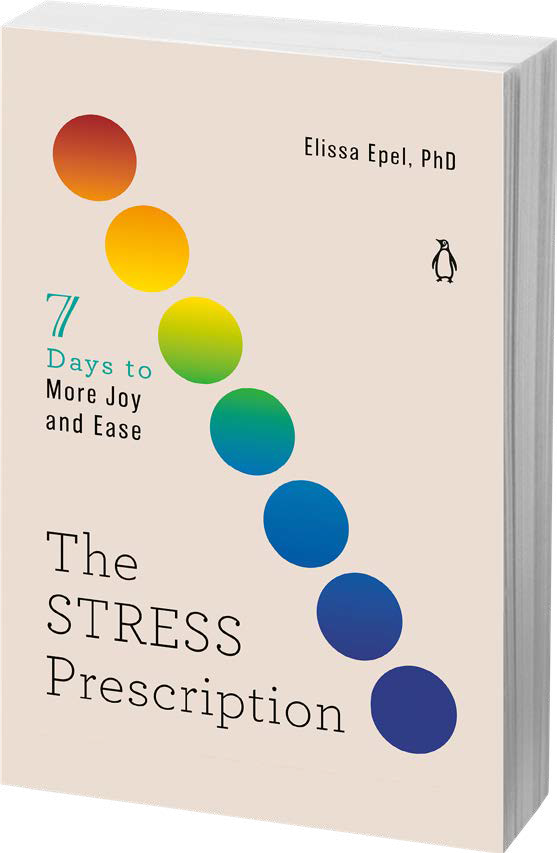
Dr. Elissa Epel published her most recent book, The Stress Prescription, in 2023. You can find a list of resources to help deal with stress recommended in the book on Dr. Epel’s website at bit.ly/Stress- Prescription-Resources
Hugging a furry animal, who doesn’t read the news and is fully present with you, is an amazing experience, if you are paying attention! It’s a sensory shift and an experience of caring and love.
As a social species, we naturally are wired to show love, caring and altruism to others, and research shows these prosocial behaviors are what makes us most happy. If we can promote a culture of these social values, we can make a huge difference in terms of public health. My colleagues and I pointed this out in a recent call to action published in Nature Human Behaviour.
It’s clear that stress shapes human health. How do you see this insight informing the practice of preventive medicine and health care itself?
The science of stress is directly relevant to the practice of preventive medicine.
“Just as we test vital signs during each check up, we can assess stress, which is a vital sign.”
High levels of perceived stress have biological effects chronically over time and stress can be mitigated with the right resources and skills.
Some electronic health records include assessments of social needs. For example, they may ask if a person has food insecurity (which creates high perceived stress) or is exposed to domestic violence (a traumatic stress).
Another common stress exposure, particularly for older adults, is being a caregiver for a disabled or ill family member. These are situations that are inherently stressful. Therefore, healthcare providers can address these critical social needs just as they address other medical health risks like smoking.
Everyone has different sources of stress in life, so it’s also important to assess the level of felt stress—how stress gets under the skin. Therefore, providers should ask how stressed one feels on a scale of 1 to 10. If an alarm is going off, ideally that can be attended to through a direct medical referral to free resources within the healthcare system or at the community level.
Ultimately, preventive medicine is about fostering healthy behaviors and skills for emotional well-being at a young age. School programs that teach mindfulness, self-care and prosociality skills are a form of early mental and physical health care that can be built into the educational system for a lifetime of well-being.
This interview has been edited for length and clarity.
If you have any questions or feedback, please contact: curalink@thecurafoundation.com
Newsletter created by health and science reporter and consulting producer for the Cura Foundation, Ali Pattillo, consulting editor, Catherine Tone and associate director at the Cura Foundation, Svetlana Izrailova.