
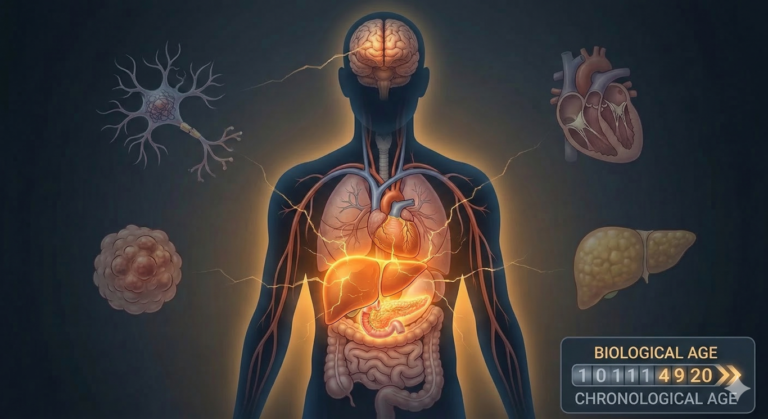
INFLAMMATION AS THE ROOT OF AGING
One Fire, Many Faces — How a Single Biological Process Unifies the Diseases of Age
A Unified Framework for Longevity, Vitality, and Disease Prevention
One Root, Many Branches: The Unifying Theory of Aging
For most of modern medicine’s history, the great diseases of aging were treated as separate problems requiring separate solutions. Heart disease lived in one clinic, Alzheimer’s in another, type 2 diabetes in a third. Cancer had its own vast kingdom of specialists. Arthritis, depression, kidney disease, macular degeneration, and frailty were each filed into their own diagnostic category, each with its own drug targets and clinical guidelines. This siloed approach produced enormous advances in treating individual conditions — but it consistently missed something that researchers studying the biology of aging had begun to notice with growing urgency: beneath the surface of almost every major chronic disease of aging, the same molecular fingerprint appeared, again and again. Inflammation.
The theory that chronic inflammation is not merely a symptom or complication of age-related disease, but increasingly recognized as a central driver and unifying mechanism shared across many of its forms, has become one of the most powerful organizing frameworks in modern gerontology and biomedical science. It has a name that captures both its elegance and its gravity: inflammaging — a term coined by Dr. Claudio Franceschi of the University of Bologna, whose decades of research on centenarians and the biology of aging established that the degree of systemic inflammatory activation is one of the most reliable predictors of both how a person ages and how long they live. The implication is both practical and far-reaching: if chronic inflammation is the shared biological soil in which so many diseases of aging take root, then addressing that fire — through diet, lifestyle, and emerging therapeutics — becomes a broad strategy for supporting health across multiple conditions simultaneously.
- Inflammaging — chronic, low-grade systemic inflammation that increases with age — is now recognized as the shared biological foundation of virtually every major age-related disease, from cardiovascular disease and cancer to Alzheimer’s and diabetes.
- Claudio Franceschi’s landmark centenarian research established that the lowest levels of systemic inflammatory markers — not genetics alone — consistently distinguish the longest-lived individuals from their peers.
- The unifying framework of inflammation as the root of aging represents a paradigm shift: rather than fighting each disease separately, addressing chronic inflammation offers a single strategy with broad-spectrum benefits across multiple conditions simultaneously.
The Mechanism: How Inflammation Becomes Aging
To appreciate how profoundly chronic inflammation shapes the aging process, it helps to understand what is actually happening inside the body when inflammation becomes chronic. Inflammation is fundamentally an immune response — a mobilization of the body’s defense systems in response to perceived threat. Normally, this response is tightly regulated: it activates, it neutralizes the threat, and it resolves, with specialized molecules called resolvins and protectins — identified through the pioneering work of Dr. Charles Serhan at Harvard Medical School — actively switching off the inflammatory cascade and repairing damaged tissue. This resolution phase is as important as the activation phase. When it fails, inflammation doesn’t simply persist — it becomes a source of damage in its own right.
The primary mediators of chronic inflammation are cytokines — small protein signaling molecules including interleukin-1 beta (IL-1β), interleukin-6 (IL-6), and tumor necrosis factor-alpha (TNF-α). In chronic low-grade inflammation, these cytokines circulate at persistently elevated levels, activating a master inflammatory transcription factor called NF-κB (nuclear factor kappa-light-chain-enhancer of activated B cells) in tissues throughout the body. NF-κB, sometimes called the “master switch of inflammation,” controls the expression of hundreds of genes involved in immune activation, cell survival, and cellular senescence. Its chronic activation creates a self-amplifying feedback loop: inflammation activates NF-κB, which drives more inflammation, which causes more cellular damage, which activates more NF-κB. Over years and decades, this loop contributes to dysfunction across multiple organ systems throughout the body.
Compounding this is the role of senescent cells — aged, dysfunctional cells that have stopped dividing but refuse to die. These cells, accumulating with age throughout the body’s tissues, secrete a toxic cocktail of inflammatory cytokines, proteases, and growth factors collectively known as the Senescence-Associated Secretory Phenotype (SASP). Research by Dr. Judith Campisi at the Buck Institute for Research on Aging has been foundational in establishing that senescent cell accumulation and the SASP are central drivers of inflammaging — creating a perpetual inflammatory microenvironment that accelerates the aging of every cell in the vicinity. The presence of even a small number of senescent cells, her research showed, can drive systemic aging effects disproportionate to their numbers.
- NF-κB — the master inflammatory transcription factor — creates a self-amplifying loop of chronic immune activation that contributes to dysfunction across multiple organ systems, accelerating aging at the cellular level.
- Senescent cells and their Senescence-Associated Secretory Phenotype (SASP) — characterized by Dr. Judith Campisi at the Buck Institute — are a primary engine of inflammaging, poisoning surrounding tissue with inflammatory signals that accelerate biological aging.
- The failure of inflammation resolution — not merely its activation — is a key driver of chronic inflammatory disease; Dr. Serhan’s identification of resolvins and protectins has opened new therapeutic pathways for restoring this resolution capacity.
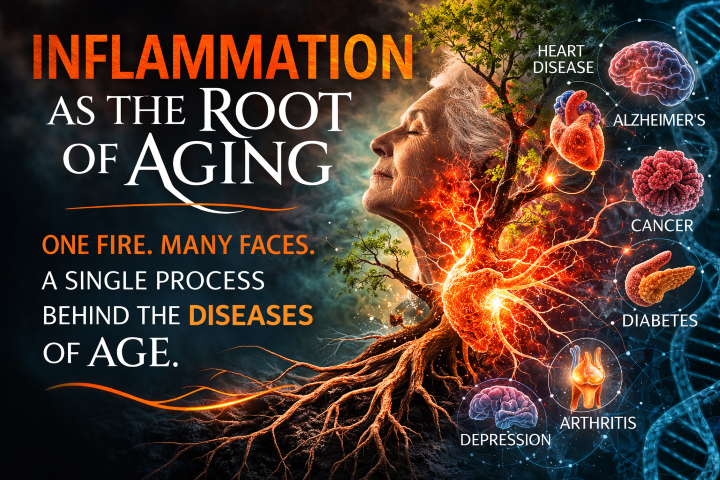
One Fire, Many Diseases: The Unified Disease Map
Heart Disease and Stroke
Cardiovascular disease has long been understood as a disease of cholesterol and plaque. But the deeper story, now well-established in the literature and reviewed in dozens of PubMed-indexed meta-analyses, is that atherosclerosis is fundamentally an inflammatory disease. LDL cholesterol becomes dangerous primarily when it is oxidized and triggers an inflammatory response within the arterial wall — a response that drives macrophage infiltration, foam cell formation, and the unstable plaque ruptures that cause heart attacks and strokes. The JUPITER trial, a landmark randomized controlled trial published in the New England Journal of Medicine in 2008, demonstrated that patients with elevated CRP but normal LDL cholesterol benefited significantly from statin therapy — in part through the drugs’ anti-inflammatory effects, in addition to their cholesterol-lowering and plaque-stabilizing actions. This was a pivotal moment: it confirmed that inflammation is an independent and central target in cardiovascular risk, alongside — not instead of — lipid management.
- Atherosclerosis is now understood as a fundamentally inflammatory disease — LDL cholesterol causes harm primarily by triggering an immune response within arterial walls, not through direct mechanical obstruction.
- The JUPITER trial demonstrated that elevated CRP — the primary blood marker of systemic inflammation — predicted cardiovascular events as powerfully as elevated LDL, validating inflammation as an independent and central target.
Alzheimer’s Disease and Neurodegeneration
For decades, Alzheimer’s disease was understood through the lens of amyloid beta plaques and tau tangles — the characteristic protein accumulations that define the disease pathologically. But a growing body of research, including work published by Dr. Rudolph Tanzi at Massachusetts General Hospital and Harvard Medical School, has increasingly recognized neuroinflammation as a major contributor to Alzheimer’s disease — one in which amyloid may function as an antimicrobial defense response that goes catastrophically wrong. Activated microglia — the brain’s resident immune cells — driven by chronic neuroinflammation, progressively impair synaptic connections and neurons in a pattern that tracks closely with cognitive decline. Elevated IL-6 and TNF-α in midlife are now established as independent predictors of Alzheimer’s risk decades later. The failure of dozens of anti-amyloid drug trials has only accelerated scientific interest in neuroinflammation as a major therapeutic target.
- Neuroinflammation — driven by activated microglia and elevated inflammatory cytokines including IL-6 and TNF-α — is now considered a primary mechanism of Alzheimer’s disease, not merely a secondary consequence.
- Elevated systemic inflammation in midlife independently predicts Alzheimer’s risk decades later, making early anti-inflammatory lifestyle intervention one of the most evidence-supported strategies for dementia prevention.
Cancer, Diabetes, and the Rest of the Spectrum
The inflammatory connection extends across the full spectrum of age-related disease with remarkable consistency. Type 2 diabetes is driven by inflammatory interference with insulin receptor signaling — IL-1β directly impairs the ability of cells to respond to insulin, and elevated CRP predicts type 2 diabetes onset years before diagnosis. Cancer’s relationship with inflammation is so well-documented that the International Agency for Research on Cancer estimates that approximately 20 percent of all cancers are directly attributable to chronic infection and inflammatory conditions — but the proportion linked to chronic low-grade systemic inflammation across all cancer types is almost certainly higher. Inflammatory cytokines promote tumor initiation through DNA damage and epigenetic disruption, support tumor progression through angiogenesis and immune evasion, and drive metastasis through matrix metalloprotease activation. Depression, osteoporosis, chronic kidney disease, age-related macular degeneration, sarcopenia, and frailty all share the same inflammatory signature. This is not coincidence. It is biology.
- IL-1β directly impairs insulin receptor function, establishing chronic inflammation as a primary — not secondary — mechanism of type 2 diabetes development and progression.
- Chronic inflammation promotes cancer through DNA damage, epigenetic disruption, immune evasion, and metastatic signaling — making systemic anti-inflammatory strategies relevant to cancer prevention, not just cardiovascular and metabolic health.
- Depression, osteoporosis, macular degeneration, sarcopenia, and kidney disease all share elevated inflammatory biomarkers as a common biological feature — confirming inflammation as a truly universal root of age-related decline.
Extinguishing the Fire: Diet as the Most Powerful Tool
Of all the modifiable drivers of chronic inflammation, diet is the most immediately powerful and the most comprehensively studied. The Dietary Inflammatory Index (DII), developed by Dr. James Hébert and colleagues at the University of South Carolina and validated in population studies involving hundreds of thousands of participants on PubMed, quantifies the inflammatory potential of dietary patterns with scientific precision. The standard Western diet — rich in refined carbohydrates, added sugars, ultra-processed foods, and red and processed meats — scores at the most pro-inflammatory extreme of this index. A whole-food, plant-forward dietary pattern — particularly the Mediterranean diet — scores at the anti-inflammatory end and is one of the most extensively studied dietary patterns for its effects on systemic inflammatory biomarkers across multiple disease categories.
The mechanisms through which the Mediterranean dietary pattern subdues inflammation are multiple and synergistic. Extra-virgin olive oil provides oleocanthal, a natural phenolic compound shown in research published in Nature to inhibit COX-1 and COX-2 enzymes — the same enzymes targeted by ibuprofen — along with oleuropein and hydroxytyrosol, which directly suppress NF-κB activation. Omega-3 fatty acids from fatty fish (EPA and DHA) shift the body’s eicosanoid production from pro-inflammatory prostaglandins toward anti-inflammatory resolvins. Dietary fiber from vegetables, legumes, and whole grains feeds the gut microbiome, which produces short-chain fatty acids — particularly butyrate — that directly suppress NF-κB and reinforce gut barrier integrity, preventing the bacterial lipopolysaccharide (LPS) leakage into the bloodstream that is one of the primary triggers of systemic inflammation. Polyphenols from berries, green tea, turmeric, and red onion activate NRF2, the body’s master antioxidant and anti-inflammatory transcription factor, and inhibit the inflammatory enzymes that NF-κB activates.
- Be mindful of overall fat quality: extremely high omega-6 to omega-3 ratios — common in diets heavy in ultra-processed foods — may favor pro-inflammatory signaling; prioritizing omega-3-rich foods helps restore a healthier balance.
- Eat fatty fish (salmon, sardines, mackerel, herring) at least twice weekly to supply EPA and DHA, which shift the body’s biochemistry from inflammatory prostaglandin production toward anti-inflammatory resolvin synthesis.
- Build every meal around a foundation of diverse, colorful plant foods — each color represents distinct polyphenol families that target different inflammatory pathways, making dietary diversity a broad-spectrum anti-inflammatory strategy.
Lifestyle as Medicine: The Full Anti-Inflammatory Toolkit
Diet is the foundation, but the full anti-inflammatory lifestyle is built on several additional pillars, each with robust mechanistic and clinical evidence. Physical activity is perhaps the most studied: a single session of moderate aerobic exercise has been shown to reduce circulating IL-6 and TNF-α within hours, and regular exercise produces adaptations in immune cell populations that sustainably lower basal inflammatory tone. Research published in Brain, Behavior, and Immunity and multiple meta-analyses has shown that regular moderate exercise can significantly reduce CRP in many studies, with the magnitude varying by baseline fitness, age, and duration of the exercise program. The mechanism involves multiple pathways, including the release of anti-inflammatory myokines from contracting muscle tissue, improved insulin sensitivity that reduces a key driver of IL-1β production, and the activation of vagal tone that directly regulates immune system activity through the cholinergic anti-inflammatory pathway.
Sleep is a non-negotiable anti-inflammatory intervention. A landmark study published in Sleep by Dr. Nathaniel Watson at the University of Washington found that even modest chronic sleep restriction — six hours per night for one week — produced significant elevations in IL-6, TNF-α, and CRP. The mechanisms involve disrupted circadian regulation of immune cell activity and impaired cortisol rhythm, which normally provides diurnal suppression of inflammatory signaling. Chronic psychological stress deserves equal attention: persistent activation of the HPA axis produces glucocorticoid resistance in immune cells — paradoxically making them unresponsive to cortisol’s normally anti-inflammatory effects — leaving pro-inflammatory cytokines chronically unchecked. Mind-body practices including mindfulness meditation, yoga, and tai chi have now been shown in PubMed-indexed randomized controlled trials to reduce IL-6, CRP, and NF-κB activity through vagal activation and HPA normalization.
- Exercise for at least 150 minutes weekly at moderate intensity — consistent aerobic activity can significantly reduce CRP across many clinical studies, shifting immune cell populations away from pro-inflammatory phenotypes in ways that compound over months of regular practice.
- Protect sleep as a biological anti-inflammatory imperative: seven to nine hours nightly maintains the circadian immune regulation that keeps cytokine production in check; chronic restriction of even two hours produces measurable inflammatory escalation within days.
- Reduce and actively manage chronic psychological stress through daily mind-body practice — mindfulness meditation, breathwork, or yoga — which restore HPA axis regulation and vagal tone, two of the body’s most powerful endogenous anti-inflammatory mechanisms.
The Longevity Return: What Cooling the Fire Gives Back
The promise of the inflammaging framework is not merely diagnostic — it is deeply, practically hopeful. Because if a single biological process underlies so many of the diseases and declines of aging, then addressing that process offers something that no single-disease pharmaceutical intervention can: simultaneous, broad-spectrum protection across the entire aging landscape. The research supporting this is not theoretical. Population studies of individuals with the lowest systemic inflammatory profiles — whether achieved through genetics, lifestyle, or some combination — consistently show dramatically lower rates of cardiovascular disease, cancer, dementia, diabetes, and all-cause mortality. These are not marginal differences. In the large epidemiological studies that have measured CRP and inflammatory biomarkers against long-term health outcomes, the difference between the highest and lowest inflammatory quartiles often represents a doubling or tripling of disease risk — and a gap of a decade or more in healthy life expectancy.
The centenarian research that launched Dr. Franceschi’s inflammaging hypothesis is instructive here. When researchers studied individuals who reached 100 years of age in good cognitive and physical health — a group sometimes called “escapers” or “superagers” — what distinguished them biologically was not the complete absence of the molecular hallmarks of aging. Many had amyloid plaques, arterial changes, and epigenetic aging markers. What they had, almost universally, was a remarkably controlled inflammatory response: lower IL-6, lower CRP, better-regulated NF-κB activity, and higher levels of anti-inflammatory mediators. They were not immune to the fire. They had simply learned, at the cellular level, to contain it. The anti-inflammatory lifestyle — rich in whole plants, quality fats, omega-3s, movement, sleep, and psychological equanimity — is the evidence-based prescription for achieving the same biology, decades earlier, in any motivated individual willing to pursue it.
- Individuals in the lowest quartile of systemic inflammation in large population studies show two to three times lower rates of cardiovascular disease, cancer, and dementia — and a healthy life expectancy gap of a decade or more compared to those in the highest quartile.
- Centenarian biology is distinguished not by the absence of aging markers but by a consistently controlled, low-grade inflammatory response — a profile achievable through sustained anti-inflammatory lifestyle practices beginning at any age.
- Anti-inflammatory living is the only known single intervention with simultaneous, evidence-based protective effects across the full spectrum of age-related disease — making it the highest-leverage strategy available for extending both lifespan and healthspan.
Chronic disease is not the inevitable cost of growing older.
It is, in large measure, the accumulated cost of unaddressed inflammation — a fire that can be cooled, contained, and in many cases extinguished, through choices that begin at your very next meal.
Key Researchers & Sources
Dr. Claudio Franceschi (U. Bologna) · Dr. Judith Campisi (Buck Institute) · Dr. Charles Serhan (Harvard)
Dr. Rudolph Tanzi (Harvard/MGH) · Dr. James Hébert (U. South Carolina) · Dr. Nathaniel Watson (U. Washington)
NEJM · Nature · Brain Behavior & Immunity · Sleep · PubMed · PNAS · International Journal of Epidemiology