

EPIGENETIC REPROGRAMMING
Rewriting the Code of Age — How Science Is Learning to Turn Back the Biological Clock
The Frontier of Human Longevity, Explained
The Code Above the Code: What Epigenetics Actually Means
For most of the twentieth century, biology operated under a reassuring simplicity: your DNA was your destiny. The sequence of base pairs you inherited from your parents determined your traits, your disease risks, and the arc of your aging. Then, gradually and then all at once, a revolution arrived. Scientists discovered that the genome — the roughly three billion base pairs encoding every protein in the human body — is not a static blueprint read the same way in every cell for a lifetime. It is a dynamic, responsive system draped in a layer of chemical instructions that can silence genes, amplify them, and fundamentally alter how the body ages. This layer is the epigenome, and its study has become one of the most consequential scientific frontiers of our time.
The word epigenetics literally means “above genetics” — from the Greek epi, meaning upon. Epigenetic modifications are chemical tags that attach to DNA and to the histone proteins around which DNA is wound, without changing the underlying genetic sequence itself. The two most studied mechanisms are DNA methylation — the addition of a methyl group to cytosine bases, typically silencing gene expression — and histone modification, which can either compact or loosen the DNA coil to make genes more or less accessible for transcription. A third layer, non-coding RNA regulation, adds further complexity. Together, these mechanisms form a kind of master control system: the same DNA sequence, read through different epigenetic lenses, produces a liver cell, a neuron, a skin cell, or an immune cell. And crucially, it produces either a young cell or an old one.
- Epigenetics refers to heritable changes in gene expression that occur without altering the DNA sequence itself — driven by DNA methylation, histone modification, and non-coding RNA regulation.
- Every cell in your body carries essentially identical DNA, yet epigenetic programming determines cell identity, organ function, and, as science now confirms, biological age.
- Unlike your genetic sequence, your epigenome is dynamic and responsive — it changes throughout life in response to diet, stress, sleep, exercise, toxins, and even thoughts and relationships.
From Conrad Waddington to Yamanaka: How the Field Was Born
The conceptual roots of epigenetics trace back to British developmental biologist Conrad Waddington, who in 1942 coined the term to describe how genes and environment interact during development. But for decades, epigenetics remained a niche corner of developmental biology, fascinating but seemingly removed from the practical concerns of aging and disease. The field’s transformation into a central science of longevity began with a series of discoveries in the late twentieth and early twenty-first centuries that fundamentally changed how researchers understood aging itself.
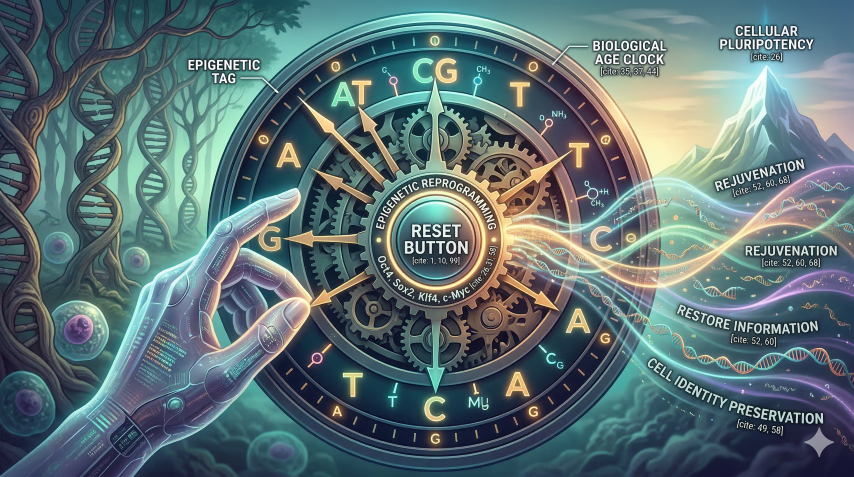
The pivotal insight came when scientists began to realize that aging was not simply the random accumulation of cellular damage — the “wear and tear” model that had dominated gerontology for generations — but a programmed, or at least programmable, process inscribed in the epigenome. A body of research across multiple groups, including work by Dr. Randy Jirtle at Duke University on epigenetic gene regulation, helped establish that identical twins — who share the same DNA — diverge substantially in their epigenetic profiles as they age, and that this divergence correlates with differences in disease risk and health outcomes. The classic twin divergence studies, including influential work published by Fraga and colleagues in PNAS in 2005, showed that environmental experience writes itself into the epigenome over a lifetime. But the watershed moment arrived in 2006, when Japanese scientist Dr. Shinya Yamanaka achieved something that had seemed biologically impossible: he took a terminally differentiated adult cell — a skin fibroblast — and reprogrammed it back to a pluripotent stem cell state simply by introducing four transcription factors, now known universally as the Yamanaka factors (Oct4, Sox2, Klf4, and c-Myc). Yamanaka was awarded the Nobel Prize in Physiology or Medicine in 2012 for this discovery. What he had demonstrated, without perhaps fully realizing it at the time, was that the epigenetic clock of aging was not simply a one-way ratchet. It could, in principle, be reset.
- Conrad Waddington coined the term epigenetics in 1942; the field’s relevance to aging and longevity was not widely recognized until the late 1990s and early 2000s.
- Shinya Yamanaka’s 2006 discovery that adult cells could be reprogrammed to a youthful stem cell state using four transcription factors — work honored with the 2012 Nobel Prize in Physiology or Medicine — opened the scientific door to epigenetic age reversal.
- Twin studies — including the influential PNAS research by Fraga and colleagues — demonstrated that epigenetic divergence accumulates over a lifetime in response to environment and behavior, and that this divergence tracks with differences in health and disease risk between genetically identical individuals.
The Clock Inside Your Cells: Horvath’s Discovery and What It Means
If Yamanaka’s discovery opened the door to reprogramming, it was Dr. Steve Horvath of UCLA who built the compass by which scientists could navigate. In 2013, Horvath published a landmark paper in Genome Biology that described what became known as the Horvath Epigenetic Clock — a mathematical model that uses patterns of DNA methylation across 353 specific sites in the genome to calculate biological age with extraordinary precision. This was not chronological age — the number of candles on your birthday cake. This was the age your cells were actually operating at, a reading of accumulated epigenetic change that predicted disease risk, cognitive decline, and mortality more accurately than any previously known biomarker.
Horvath’s clock and its successors — including DNAmPhenoAge, developed by Dr. Morgan Levine, and GrimAge, which predicts time-to-death with remarkable accuracy — revealed something both humbling and electrifying. People’s biological ages diverge dramatically from their chronological ages. Two sixty-year-olds can have biological ages of fifty and seventy-five respectively, and these differences track closely with their health, vitality, and life expectancy. More importantly, subsequent research showed that the epigenetic clock is modifiable. Interventions — dietary, behavioral, pharmaceutical, and increasingly technological — can measurably slow, and in some cases reverse, the epigenetic clock. A 2021 pilot study by Dr. Kara Fitzgerald, published in the journal Aging, demonstrated that an eight-week diet and lifestyle intervention reduced biological age by an average of 3.23 years as measured by the Horvath clock — a result that generated significant scientific and popular attention. As with all pilot trials, larger replication studies are ongoing and needed to confirm its scope.
- The Horvath Epigenetic Clock, based on DNA methylation patterns at 353 genomic sites, allows scientists to measure biological age — the actual functional age of your cells — independently of chronological age.
- Biological age measured by epigenetic clocks is a stronger predictor of disease risk and mortality than chronological age, and differs significantly between individuals with similar lifestyles.
- Kara Fitzgerald’s 2021 pilot trial demonstrated that targeted diet and lifestyle intervention reduced biological age by over three years in eight weeks — one of the first human studies to show measurable epigenetic clock reversal, with larger replication trials underway.
The Frontier: Leading-Edge Technologies in Epigenetic Reprogramming
Partial Reprogramming: The Yamanaka Shortcut
The most exciting — and most consequential — development in epigenetic reprogramming science over the past decade has been the refinement of partial reprogramming: using Yamanaka factors not to fully revert cells to stem cells (which risks tumor formation and loss of cellular identity), but to apply them briefly and cyclically to attempt to reset the epigenetic clock while preserving the cell’s functional identity. Dr. Juan Carlos Izpisua Belmonte at the Salk Institute for Biological Studies published a landmark 2016 study in Cell demonstrating that mice with a premature aging syndrome could have their aging dramatically reversed — and their lifespan extended by 30 percent — through cyclic partial reprogramming. More recently, his group and others have shown that partial reprogramming can restore vision in aged mice, improve muscle regeneration, and reverse epigenetic aging markers in multiple tissues. Harvard’s David Sinclair and colleagues have argued, in published work and widely cited reviews, that the loss of epigenetic information — rather than DNA sequence damage per se — may be a primary driver of aging, and that restoring this information through reprogramming could produce meaningful rejuvenation. This hypothesis has generated significant scientific debate and ongoing investigation in animal models.
Multiple biotechnology companies have now launched with partial reprogramming as their central technology. Altos Labs, launched in 2022 with over three billion dollars in funding and scientific advisors including Yamanaka himself, is perhaps the most prominent, with a research mission explicitly centered on cellular rejuvenation. Turn Biotechnologies, NewLimit (co-founded by Coinbase CEO Brian Armstrong), and Retro Biosciences (backed by Sam Altman) are among others working to translate partial reprogramming toward eventual human therapies. The field has moved from theoretical possibility to intense preclinical investigation and company formation at remarkable speed — though human therapeutic programs remain in early development stages.
- Cyclic partial reprogramming — brief, controlled application of Yamanaka factors — aims to reset the epigenetic clock in cells while preserving their identity, with the goal of reducing the tumor and identity-loss risks associated with full reprogramming.
- Altos Labs, Turn Biotechnologies, NewLimit, and Retro Biosciences represent a multi-billion-dollar wave of investment in epigenetic reprogramming as the central strategy for human life extension.
- David Sinclair and colleagues have proposed the Information Theory of Aging — the hypothesis that aging is fundamentally a loss of epigenetic information — arguing that restoring it through reprogramming could produce genuine biological rejuvenation; this remains an active and debated area of research.
CRISPR Epigenetic Editing and Small Molecule Approaches
Beyond reprogramming, two additional technological frontiers are advancing rapidly. Epigenetic editing using CRISPR-based tools — particularly CRISPRa and CRISPRi systems that can activate or silence specific genes without cutting DNA — allows scientists to rewrite epigenetic marks at precise genomic locations with unprecedented accuracy. Researchers at the Salk Institute and elsewhere have used these tools to reactivate silenced longevity genes and suppress pro-aging gene networks in human cell models. Separately, the search for small-molecule compounds that could mimic reprogramming effects without viral vector delivery is an active area of investigation: researchers including those at Harvard have published work exploring chemical cocktails that appear to partially rejuvenate aged cells in culture, though this field is early and findings are still being validated. Senolytics — drugs that selectively eliminate senescent “zombie” cells whose inflammatory secretome contributes to epigenetic aging in surrounding tissues — represent another pharmacological approach, with compounds including dasatinib and quercetin in human clinical trials through the Mayo Clinic’s research group led by Dr. James Kirkland.
- CRISPR-based epigenetic editing tools can precisely reactivate silenced longevity genes or suppress pro-aging networks without altering the underlying DNA sequence — a surgical approach to epigenetic medicine.
- Small-molecule approaches to epigenetic rejuvenation are an active early-stage research area, with published work exploring chemical cocktails that may partially reverse epigenetic aging markers in cell culture — findings that remain preliminary but promising.
- Senolytics — compounds including quercetin and dasatinib — are in active human clinical trials and work by clearing senescent cells whose inflammatory signals accelerate epigenetic aging in neighboring tissues.
What You Can Do Now: Epigenetic Lifestyle Medicine
While pharmaceutical and technological reprogramming therapies are years from clinical availability, the evidence that everyday behaviors powerfully modify the epigenome — and measurably slow the epigenetic clock — is robust, well-replicated, and immediately actionable. This is one of the most encouraging scientific stories of the past decade: you are not a passive recipient of your epigenetic fate. You are its co-author, every single day.
Diet exerts perhaps the most direct influence. Methyl-donor nutrients — folate (abundant in leafy greens and legumes), B12, choline, and betaine — are the literal biochemical raw material for DNA methylation, the primary mechanism of the epigenetic clock. A deficiency in these nutrients measurably accelerates biological aging. Dr. Kara Fitzgerald’s trial that reversed biological age by over three years was built around a diet deliberately rich in these methyl donors alongside cruciferous vegetables, liver, eggs, beets, and sunflower seeds, paired with probiotic support and restricted carbohydrates. Polyphenols — particularly resveratrol, quercetin, EGCG from green tea, and sulforaphane from broccoli — have been shown to modulate histone deacetylase (HDAC) and DNA methyltransferase (DNMT) enzymes, essentially mimicking some of the effects of pharmaceutical epigenetic drugs through food. Caloric restriction and intermittent fasting activate SIRT1 and other sirtuins — the epigenetic maintenance proteins that David Sinclair has spent his career studying — which help preserve the fidelity of epigenetic marks as cells age and divide.
- Prioritize methyl-donor foods daily: dark leafy greens, legumes, eggs, liver, beets, and sunflower seeds supply the folate, B12, choline, and betaine that are the literal raw material of healthy DNA methylation.
- Consume polyphenol-rich foods — green tea (EGCG), broccoli sprouts (sulforaphane), berries, and dark chocolate — which modulate HDAC and DNMT enzymes and produce measurable epigenetic anti-aging effects.
- Practice intermittent fasting or time-restricted eating to activate sirtuins, the NAD+-dependent epigenetic maintenance proteins most directly linked to epigenetic clock preservation.
Exercise has profound and well-documented epigenetic effects, particularly aerobic exercise, which has been shown in PubMed-indexed studies to reduce biological age as measured by the Horvath clock. Resistance training promotes BDNF expression through epigenetic mechanisms and has been shown to partially reverse age-related methylation changes in muscle tissue. Sleep, as in so many areas of longevity science, is irreplaceable: deep sleep stages are the primary window during which DNA repair, including epigenetic maintenance, is most active. Chronic sleep restriction produces measurable epigenetic aging acceleration. Reducing exposure to environmental toxins — cigarette smoke, air pollution, pesticides, and heavy metals — is also critical, as these are among the most potent known environmental drivers of epigenetic clock acceleration. And finally, perhaps unexpectedly, social connection and psychological wellbeing have now been linked in multiple studies to slower epigenetic aging: loneliness and chronic stress accelerate the clock, while purpose, connection, and positive affect measurably slow it.
- Regular aerobic exercise measurably reduces biological age as measured by DNA methylation clocks — aim for 150+ minutes weekly of moderate-intensity cardio.
- Protect sleep as a non-negotiable epigenetic maintenance window: 7–9 hours of high-quality sleep per night is among the most powerful interventions for slowing biological aging at the epigenetic level.
- Minimize exposure to epigenetic accelerants: tobacco smoke, air pollution, pesticides, excess alcohol, and chronic psychological stress all measurably advance the biological clock and are modifiable through conscious lifestyle choices.
The Promise Ahead: A New Relationship with Age
We are living at a genuinely extraordinary moment in the history of medicine. For the entirety of human history, aging was understood as an irreversible biological inevitability — the slow, one-way dimming of cellular function that no knowledge or technology could reverse. Epigenetic science has fundamentally challenged that assumption, and the challenge is generating serious scientific momentum. The convergence of epigenetic clock technology, partial reprogramming biology, CRISPR-based editing tools, and a growing understanding of how lifestyle shapes the epigenome has created a scientific ecosystem in which leading researchers are actively debating not just whether biological age can be slowed, but whether meaningful reversal is achievable — and by what means. The leading scientists in this field — Sinclair, Horvath, Belmonte, Fitzgerald, Levine — speak with a striking optimism grounded in experimental data, even as the field acknowledges that much of its most exciting work is still in animal models and early-stage human research.
What this means for you, right now, is both practical and profound. The choices you make every day — what you eat, how you move, how you sleep, how you manage stress, how deeply you invest in human connection — are not merely lifestyle preferences. They are epigenetic instructions written into your cells, shaping the biological age at which your body operates and the vitality with which you move through the world. The technology of full reprogramming is coming. But the technology of epigenetic self-care is already here, already validated, and already within reach of anyone willing to use it.
- Epigenetic reprogramming represents one of the most actively investigated pathways toward biological age reversal — with compelling animal data now driving serious investment in translating these findings toward eventual human application.
- The daily lifestyle behaviors with the strongest epigenetic clock-slowing evidence are: methyl-donor-rich diet, polyphenol intake, regular aerobic exercise, consistent high-quality sleep, intermittent fasting, and stress reduction.
- You are not a passive recipient of your epigenetic age — every day offers dozens of opportunities to write younger instructions into your biology, and the science to guide those choices has never been richer.
Your DNA is the instrument. Your epigenome is the music.
And unlike the instrument itself, the music can change — every single day, with every choice you make.
Key Researchers & Sources
Dr. Steve Horvath (UCLA) · Dr. David Sinclair (Harvard) · Dr. Shinya Yamanaka (Gladstone/Kyoto, Nobel 2012)
Dr. Juan Carlos Izpisua Belmonte (Salk Institute) · Dr. Morgan Levine (Yale) · Dr. Kara Fitzgerald (IFM)
Genome Biology · Cell · Nature · Nature Medicine · Aging · PubMed · PNAS